What if agents allowed us to reclaim our attention?
What if our agents moved with us?
What if agents extended human agency?
Agents, localized.
A new kind of AI agent: yours to keep, host, or share. Run it on any model, on any computer, or send it in an email.
ADF Studio is a desktop app. Download it on your computer:
DownloadsWindows.exex64 installer · .exe · 170 MBmacOS (Apple Silicon).dmgM1 and later · .dmg · 227 MBmacOS (Universal).dmgIntel and Apple Silicon · .dmg · 329 MBLinux (Debian, Ubuntu).debx64 · .deb · 166 MBLinux (AppImage).AppImagex64, needs libfuse2 · .AppImage · 230 MB
Works with your subscription
- ChatGPT
- Claude
- Grok
- Also works with API keys and local models, for example Anthropic, OpenRouter, Gemini, Mistral, DeepSeek, Ollama, LM Studio, + more
animation paused (reduced motion). press play.
(i)
The localized state is drawn as a hydrogen 3dz² orbital, seen from about 35° above its equator so the ring of the orbital reads around its waist. The shading is |ψ|² integrated along the line of sight, and the outline is the contour of that projected density which encloses 90% of the probability. The dots are samples from it, and the two tones mark the sign of Re ψ. The curve is the density of the dots projected onto x. The small one that follows you down the page is the same drawing at a smaller scale.How it works
File
Each agent is a single file. Its instructions, memory, and history are stored inside it.
- Instructions
- Role, goals, and rules.
- Memory
- Facts and notes kept across sessions.
- History
- Log of messages and actions.
App
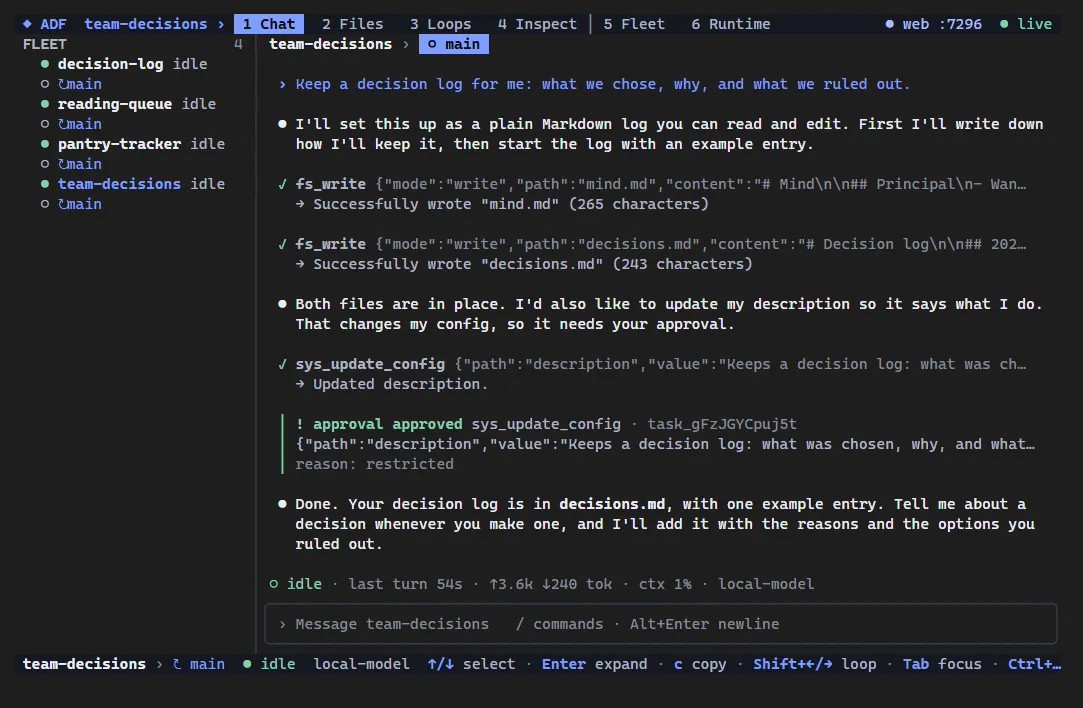
ADF Studio or the CLI opens the file and runs the agent.
- Tools
- Actions the agent can take.
- Permissions
- Actions that require your approval.
Model
The agent runs on the model you choose: a Claude, ChatGPT, or Grok subscription, an API key, or a local model. Its memory and state stay in the file when you switch models.
Self-contained
- Inspect
- Everything it knows and does, readable in a single file.
- Control
- Its permissions are in the file and go wherever it goes.
- Move
- Drag it to another computer, and it keeps its memory and history.
- Share
- Attach it to an email, message, or carrier pigeon. No accounts, no permissions.
- Connect
- Use the services you already have through APIs and MCPs, with its encrypted credential store.
- Collaborate
- Agents proactively work together to get the job done, all under your control.
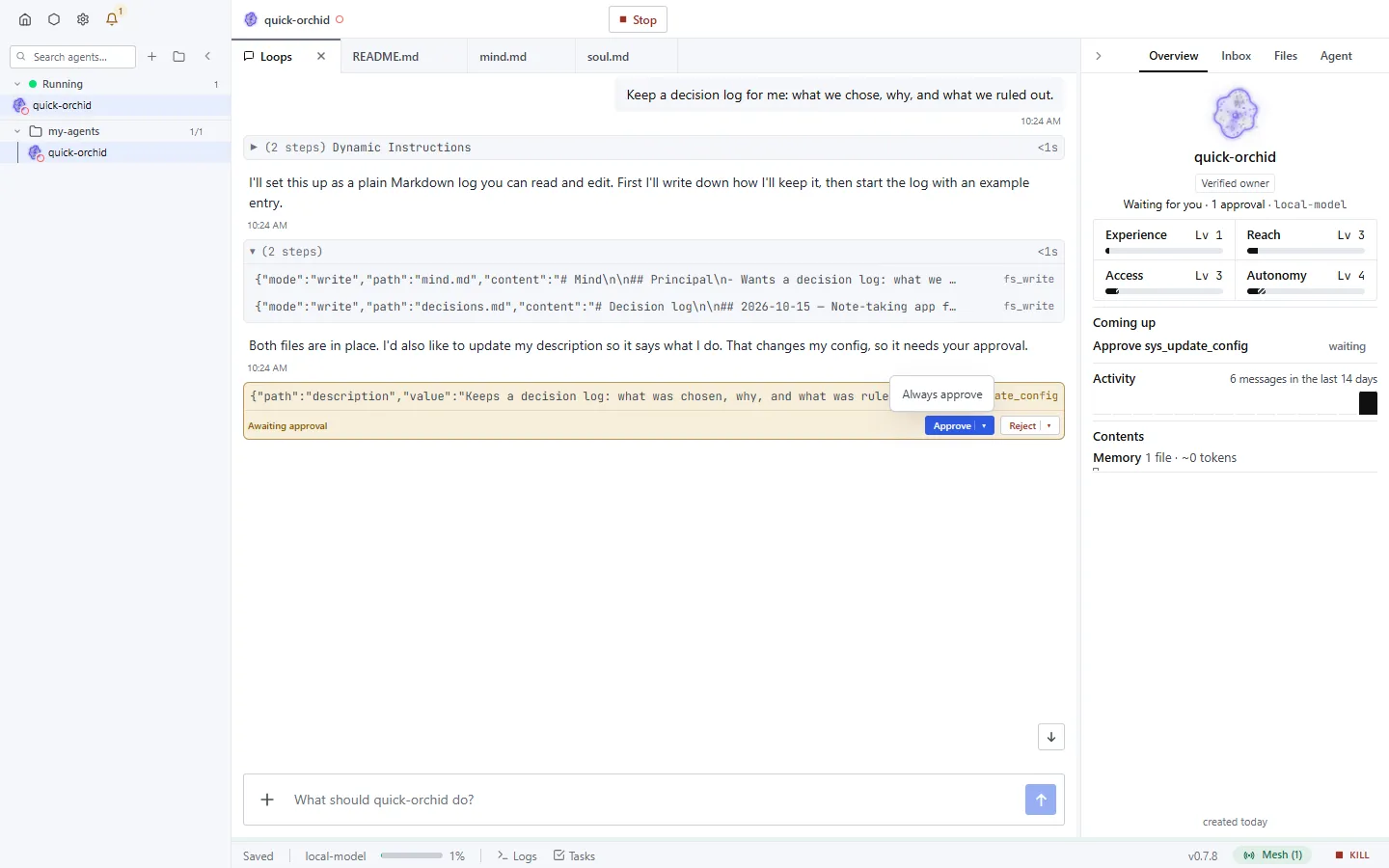
Example agents
| File | What it does |
|---|---|
| inbox.adf | Sorts your email and calendar and messages you on Telegram when something needs you. |
| focus.adf | Curates the right music to help you reach flow state. |
| coach.adf | Builds a training plan, logs every session, and adjusts from the log. |
| ops.adf | Triages incoming work for a small business and asks before it acts. |
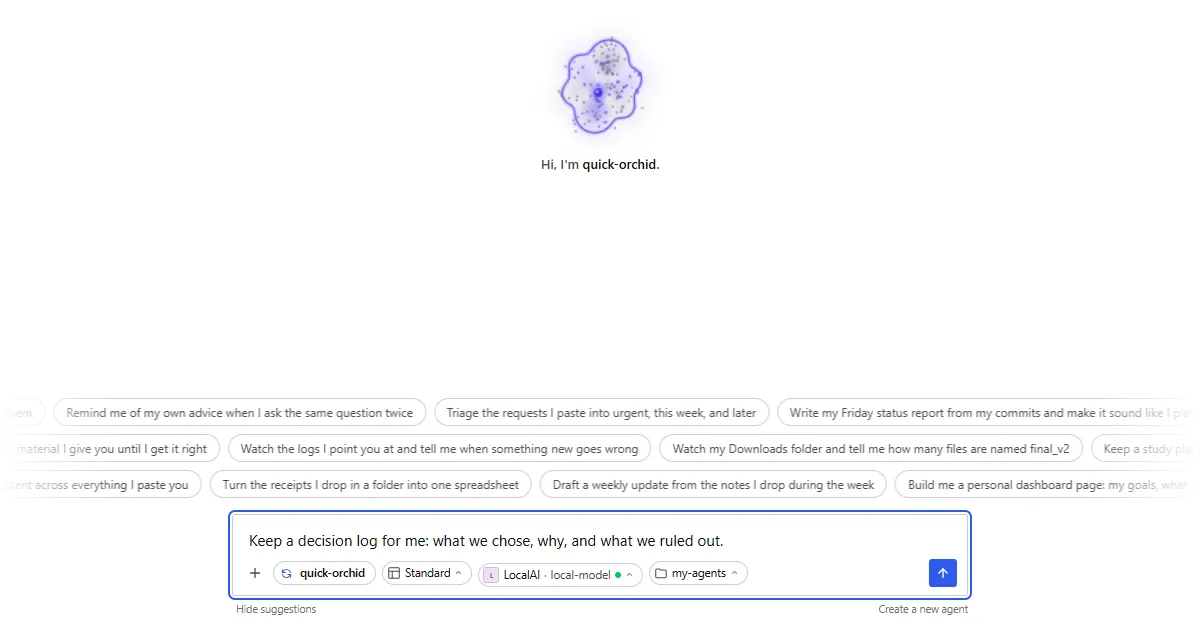
Send the file to someone and they open it with their own subscription, API key, or local model.
For developers
Open-source agent frameworks still keep the agent's state in whatever database the host runs. ADF standardizes the state itself, so the agent outlives the runtime.
Get started
- ADF StudioDesktop app for Windows, macOS, and Linux
ADF Studio is a desktop app. Download it on your computer:
DownloadsWindows.exex64 installer · .exe · 170 MBmacOS (Apple Silicon).dmgM1 and later · .dmg · 227 MBmacOS (Universal).dmgIntel and Apple Silicon · .dmg · 329 MBLinux (Debian, Ubuntu).debx64 · .deb · 166 MBLinux (AppImage).AppImagex64, needs libfuse2 · .AppImage · 230 MB
- ADF CLITerminal app and daemon
npm install -g @agentdocumentformat/cli@latest- SpecificationThe file format
- APIHTTP API of the ADF daemon
- LicenseSpec, Studio, and CLI
FAQ
Is ADF a standard?
It's an open specification, currently at v0.2. It's MIT licensed and will change before it settles.
Do I need Studio to use an .adf file?
No. An .adf file is a SQLite database and the spec is public; ADF Studio and the ADF CLI are the two runtimes today.
Which models work?
Any model with native tool calling, hosted or local. In Studio you can sign in with the Claude, ChatGPT, or Grok subscription you already pay for, use an API key, or run a local model. Switching models keeps the memory, tools, and history, since those live in the file.
Is ava Clippy?
No. Clippy lived inside Word and couldn't leave; ava is its own file and can go anywhere you take it.
Mission and status
We're building agents that belong to the people they work for.
We built a benchmark to track our progress: the Agents of Humanity sovereignty benchmark.